Saturday, June 2, 2007

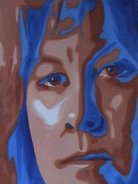
Purple Passion Flower


Moroccan Passion Flower (self portrait), 2001
Gouache, cut & torn paper on bristol board

During the time that I created Moroccan Passion Flower, I was spending a lot of time reading about color; it's meaning and symbolism, how colors interact and relate to one another, and the affect of color on the human psyche. This was also a time of great personal introspection and meditation, and I was creating art with fervor.

This painting resulted from many hours, standing before a mirror, sketching quick self-portraits in a linear style. I ended up with a stack of portraits--probably close to 50 of them--which I then dissected; taking the eye from one, the nose from another--piece by piece I worked. Eventually, I had a self portrait puzzle: me in different moods, me with different thoughts trailing through my mind, but all gathered together into one self portrait. That finished hodgepodge of paper became the basis for this painting.

Moroccan Passion Flower is about an artist (me) following her passion; thriving and growing like a wild vine as a result.

Thursday, May 31, 2007

Handbuilding


Handbuilding, 2002 ceramic and clear glaze 7" x 7" x 4"

Handbuilding refers to what I do as a ceramic artist. Generally speaking, ceramics is divided into two separate processes: Handbuilding, and wheel throwing. I prefer handbuilding for a couple of reasons. The first, and most important to me (at least initially) is that handbuilding allows me to spend time with my work. Using a combination of methods: pinch, coiling, slab work, carving, etc., I form the piece into the vision that occupies my mind. The idea that every nuance; every bulge, dent, line, crease, smooth and/or rough area are put there intentionally really appeals to me. I love the imperfection of it all. It implies that the work has resulted from a member of the human race--and not a machine. Handbuilding also makes each piece special, unique.

Another reason why handbuilding so appeals to me has to do with the role of women in ceramics, from an historical perspective. Historically, pottery made by women was done by hand and foot. We would gather the clay, clean and process it, and often mix it with our feet. Then, when it was "just right," it would be transformed--by hand--into something that was almost always functional, but often very sculptural and beautiful, as well. Men have, historically, also made ceramics; but their method of choice was the potter's wheel. Yes, this allowed for faster work--which, in turn, led to production pottery--but my aim, first and foremost, has been to create art. If I can make a functional ware beautiful and sculptural, so much the better. But I do not desire to create mass quantities of identical (or near identical) wares. Everything thing I make is an extension of myself; a piece of me.

In many parts of the world--Africa and Native America come to mind immediately--pottery made by women is considered sacred and mysterious. And it is hand built. When I work with clay, I feel that I'm part of a large, universal Sisterhood--a group that I'm both humbled, and honored, to be a part of.

Wednesday, May 30, 2007

Forging Ahead: Portraits

Atchison Gothic, Acrylic on canvas

Doing portraits is a great exercise, good practice--an excellent way to stay artistically nimble. And copying a famous artist's work (or their style) is a great way to get inside the mind of that artist. Each brush stroke, each color choice, reveals something intimate and wonderful about the artist.

Buddha Babe, Watercolor and acrylic on paper

My personal opinion on copying another's work, though, is this: If I'm going to copy something, I want it to be an "obvious forgery." I don't want to want to pass the work off as completely my own. That wouldn't be fair or ethical.


Shannon With a Pearl Earring, Acrylic on paper

Hence, one of my favorite things to do--to stay in good practice and to learn about an artist I'm fond of--is to copy a painting (or heavily borrow from a particular style) and put someone I know into it as its main subject.

Multiple Self Portrait, Oil on board

These final three paintings are inspired by the work of Gustav Klimt. The thing that most appeals to me about his work is the way that he hides his subjects, surrounds them, in a blanket of strongly linear and colorful patterns. Often, only their faces and hands are obvious, and he makes the viewer work a little bit to find the outline of the subject's body.

Erica, Watercolor on paper

Art that requires some work--whether a bit of introspection, inquiry, or figuring out an optical illusion or hidden picture--really appeals to my senses. It engages the viewer; forces them to stay a little bit longer, and to become an extension of the art through their personal interaction.


Shannon, Watercolor on paper


Tuesday, May 29, 2007

Homage to Frida Kahlo


The Kahlo Tree, 2001 Monoprint & Linocut (limited edition) 12" x 12"

Like many artists, I will often revisit an idea. The Kahlo Tree (linocut) is a re-interpretation of a painting that I had done about 5 years prior, and is a tribute to one of my favorite artists, Frida Kahlo. By depicting Kahlo as a tree, I was illustrating my feelings of connection to her (she's the only person, other than myself, that I've depicted as a tree or flower).

Her life was filled with pain and heartache, and yet she was a highly prolific artist.


603 Days Until the BIG PARTY!!!

Monday, May 28, 2007

Moroccan Passion Flower: The Sculpture


Self Portrait (Moroccan Passion Flower)

I've been doing self portraits for as long as I can remember, and most of them are representations of myself as a flower or tree. I don't really know where this came from, because I started these when I was very young. It may have something to do with my profound love of, and connection to, the natural world around me. I've always felt that every living thing, no matter how inanimate in appearance, has feelings.

This self portrait is about my passion for art. The more I do and learn, the more I grow.

The seed packet contains lots of tiny seeds. On each one is the name of someone who has given me inspiration, or taught me something about myself that is so profound that it's affected my art. It's sealed up completely, and I'm the only one who knows the names on the seeds inside. The image on the packet is another self portrait.

With exception to the pail and bucket, the sculpture was created from found wire and screen. When the flower was complete, I put some paint into the pail, and poured it over the flower.

Art is the fuel that keeps me going.

Sunday, May 27, 2007

Art from Rescued Materials

Head, 1994 Wood and Acrylic

Head was created from scrap pieces of found wood--most of them from a construction project near my former home. I was driving along, passed by a home that was being remodeled, and noticed a large pile of wood overflowing in a trash can. I immediately stopped and asked if the wood was going to be thrown away. It was. The workers helped me to load quite a lot of scrap wood into my car, and I took it home--rescuing it from a terrible fate.

Let me say that it disturbs me to see so much stuff taken to landfills. Much of what ends up there is still useful; still has some life in it. To know that a large, majestic tree has given its life to become "lumber," and that a good portion of that lumber will end up in the waste bin almost brings tears to my eyes. So I took these beautiful bits of a former tree home and examined them. Soon, the shapes implied a presence. I combined them with other bits of "waste" wood that I'd gathered, and created this sculpture. I used each piece that I selected just as it was--not removing anything (not making waste), and not trying to make it too "perfect." It's not perfect. Some pieces are cracked, some are overly rough, and some lack symmetry. Not too different from many humans I know. There's something very wonderful and approachable about imperfection. It's a sign of humanity.

Much of my work with found and rescued objects is figurative. I like to draw parallels between people and objects. Turning objects into people, or figures, is a good way to achieve that goal. We are so caught up in buying, using, and tossing "things." We often feel defined by our possessions. We are also defined by what we abandon. Waste not, want not.

604 Days Until the BIG PARTY!!

Friday, May 25, 2007

Crime on the Mesa

So often we believe that bad things only happen to other people, in other places. Living out in the country, we feel insulated from crime. But recently something very disturbing happened just down the road from us, at our good friends' (Sue and Darwin's) home.

They were gnomed. That's right. It happened right here in our little community.

Sue and Darwin came home to find this gnome sitting atop their horno; and the lack of surface dust, combined with fresh prints in the dirt indicated that the crime had recently occurred. Neighbors, when questioned, scratched their heads and all agreed that no "strange" visitors had been seen in the area. But, as is so often seen in the news lately, the "Deranged Gnomer," as the culprit has come to be known, had the unmitigated gall to document their handiwork.

Imagine our shock, dismay, and shame when we learned that it was our own little Frida. Where did we go wrong?

Sue and Darwin have always treated her like a daughter, so they were understandably hurt and upset when they learned of the Deranged Gnomer's identity.


We didn't see this coming. She's always been the perfect little dog. Why she would want to gnome such good and decent people is beyond us. We're looking into family counseling, and we're keeping her on a tight leash.

We'd like to use this public forum to offer our most sincere apologies to Darwin and Sue. I know that we can't take the gnome incident back, but I hope that we'll be able to find closure, and then move on.


606 Days Until the BIG PARTY!!!